
What is a cooling tower and how does it work?
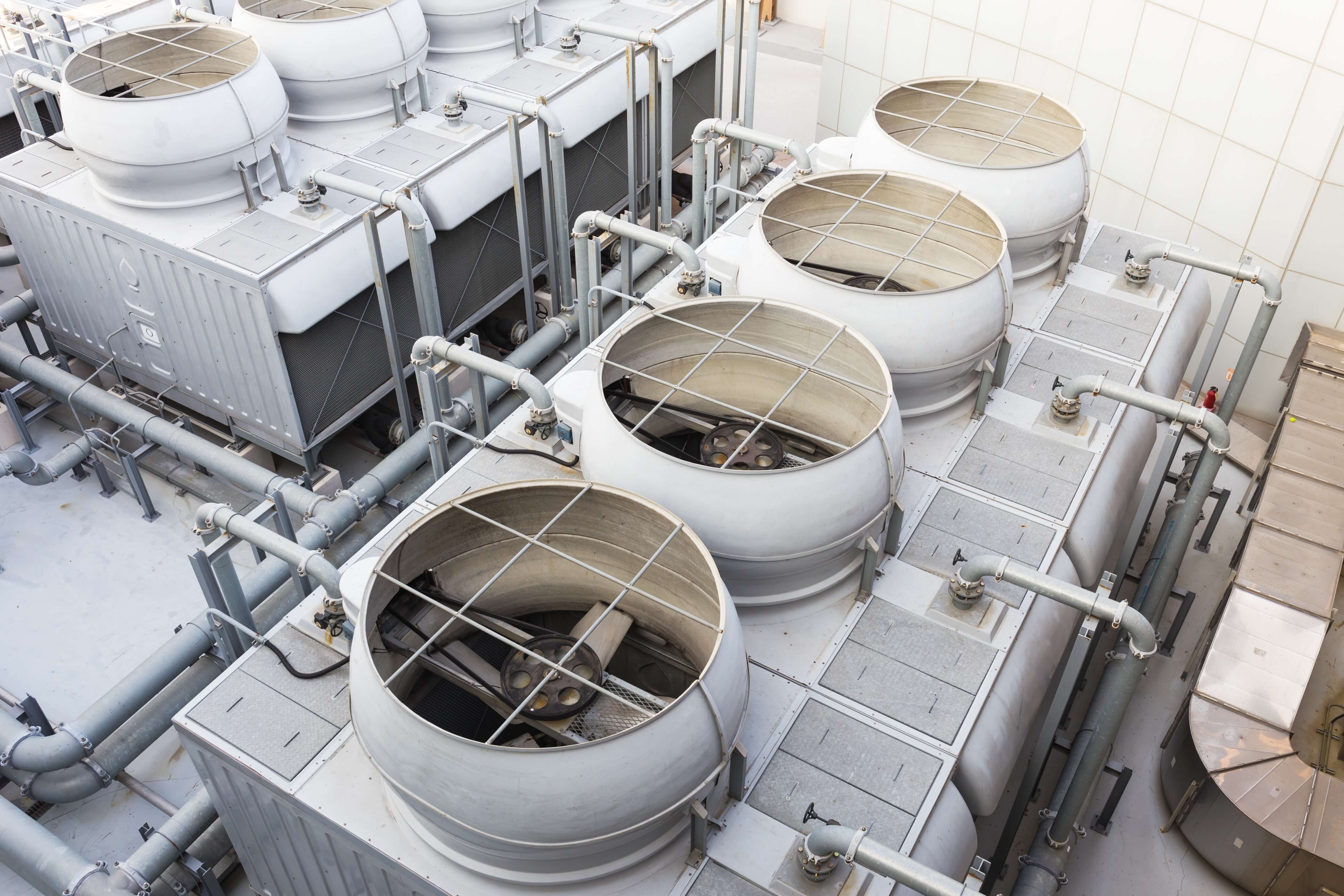
Cooling towers are an essential part of many large HVAC and industrial systems, even though most people never see or think about them. You’ll typically find them on rooftops of commercial buildings, hospitals, manufacturing plants, data centers, and large office complexes. Their job is simple in concept but extremely important in practice: they remove heat from water used in cooling systems and release that heat into the atmosphere.
Without cooling towers, many large buildings would struggle to maintain stable indoor temperatures, and industrial equipment would overheat quickly. Understanding how they work helps property owners and facility managers make better decisions about efficiency, maintenance, and long-term system performance.
What Is a Cooling Tower?
A cooling tower is a heat rejection device that removes excess heat from water used in HVAC systems or industrial processes. Instead of directly cooling air like an air conditioner, it cools water that has already absorbed heat from chillers, compressors, or machinery.
Once the water is cooled, it is recirculated back into the system to absorb more heat. This continuous cycle allows large buildings to maintain consistent cooling without overloading HVAC equipment.
Cooling towers are most commonly used in:
- Commercial office buildings
- Hospitals and healthcare facilities
- Industrial plants
- Data centers
- Hotels and large residential complexes
- Manufacturing facilities
How Does a Cooling Tower Work?
The operation of a cooling tower is based on a simple principle: evaporative cooling.
Here’s how the process works in real terms:
First, warm water from the building’s HVAC system flows into the cooling tower. This water has absorbed heat from chillers or equipment inside the building.
Next, the warm water is distributed over a fill material inside the tower. This fill increases the surface area of the water, allowing it to come into contact with moving air more effectively.
At the same time, a large fan pulls or pushes air through the tower. As the air moves across the water, a small portion of the water evaporates.
This evaporation process removes heat from the remaining water, lowering its temperature. The cooled water is then collected at the bottom of the tower and pumped back into the HVAC system to absorb heat again.
Meanwhile, the warm, moist air exits the top of the tower, releasing the absorbed heat into the atmosphere.
Key Components of a Cooling Tower
Even though cooling towers come in different sizes and designs, most share several core components:
The structure itself, which houses all internal systems and directs airflow.
Fill media, which increases the contact surface between air and water for better cooling efficiency.
Distribution nozzles, which evenly spread water across the fill to maximize heat exchange.
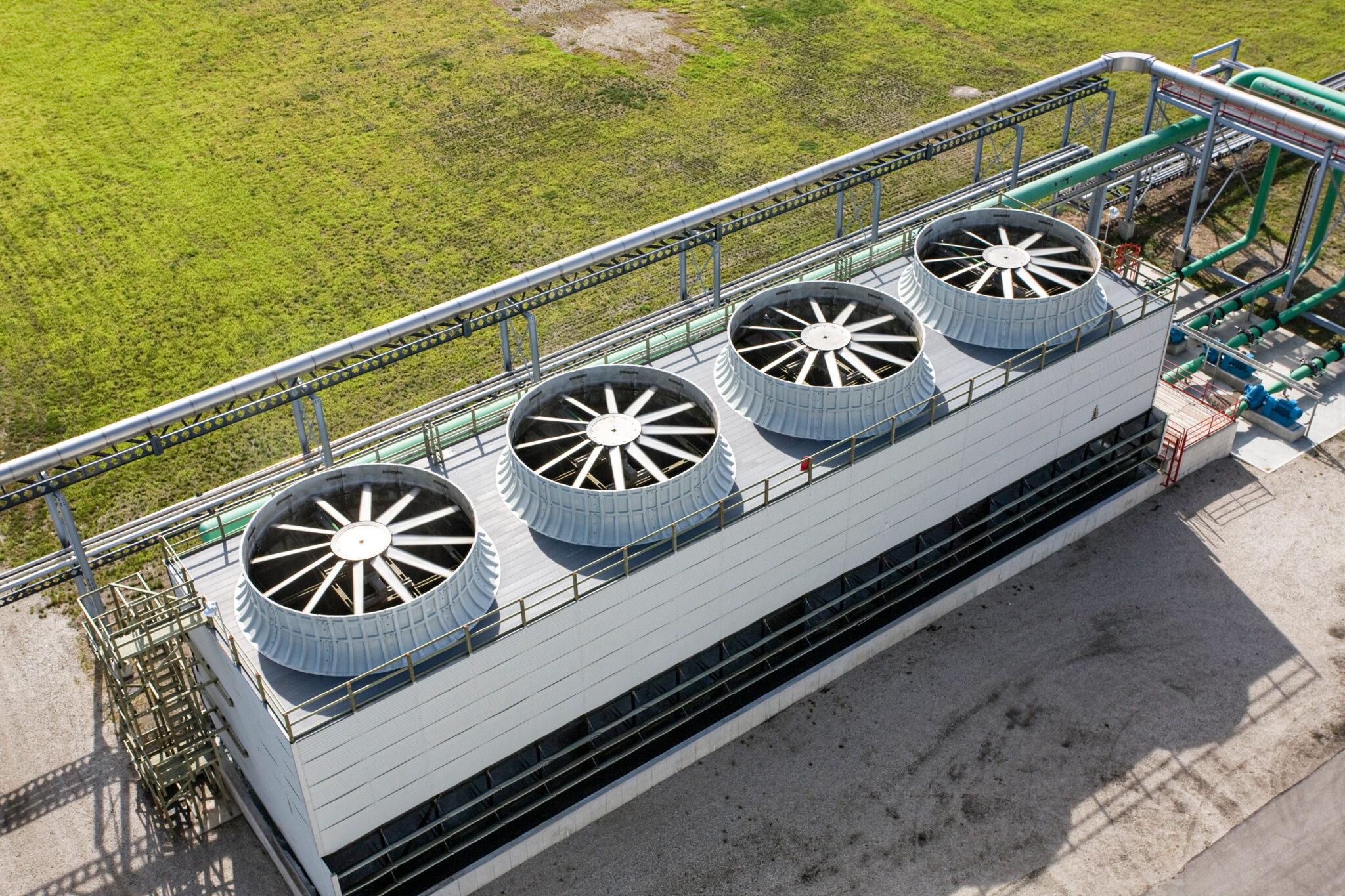
Fans, which move air through the system in mechanical draft towers.
Drift eliminators, which reduce water loss by capturing droplets before air exits the tower.
Cold water basin, which collects cooled water before it is recirculated.
Each of these parts plays a role in maintaining efficiency and preventing water waste.
Types of Cooling Towers
Cooling towers generally fall into two main categories: open circuit and closed circuit systems.
Open circuit towers, also known as wet cooling towers, allow water to directly contact air. These are the most common and efficient types but require regular maintenance due to exposure to environmental contaminants.
Closed circuit towers keep process water inside a sealed loop while using an external coil system to transfer heat. These are often used when water cleanliness is critical or when systems require more controlled operation.
Both types rely on the same principle of heat transfer through evaporation and airflow.
Why Cooling Towers Are Important in HVAC Systems
Cooling towers play a critical role in large-scale HVAC systems because they make it possible to efficiently remove heat from buildings that generate high cooling loads.
Without them, chillers would have to work much harder, increasing energy consumption and reducing system lifespan.
By using evaporative cooling, cooling towers significantly improve overall system efficiency and help reduce operating costs for large facilities.
They are especially important in environments where consistent cooling is required 24/7, such as hospitals or data centers where temperature stability is critical.
Energy Efficiency and Operational Benefits
One of the biggest advantages of cooling towers is energy efficiency.
Because evaporation naturally removes heat, cooling towers require less mechanical energy compared to traditional air-cooled systems. This reduces electricity usage and lowers operational costs for large buildings.
Other benefits include:
- Improved HVAC system efficiency
- Reduced wear on chillers and compressors
- Lower long-term operating costs
- Ability to handle large cooling loads
- Reliable performance in demanding environments
When properly designed and maintained, a cooling tower can significantly improve the overall performance of a building’s cooling system.
Maintenance Requirements and Common Issues
Cooling towers require regular maintenance to operate efficiently and safely.
Over time, mineral buildup, algae growth, dirt, and debris can accumulate inside the system. This reduces heat transfer efficiency and can lead to higher energy consumption.
Common issues include scaling, corrosion, biological growth, and mechanical wear in fans or pumps.
Water quality is especially important. Poor water management can lead to system inefficiency and even equipment damage if not properly controlled.
This is why many facilities rely on professional cooling tower water treatment support to maintain proper chemical balance, prevent biological contamination, and ensure long-term system reliability.
Regular inspections, cleaning, and water treatment are essential for preventing costly repairs and extending equipment lifespan.
Cooling Towers in Commercial Buildings
In commercial HVAC systems, cooling towers are often part of a larger chilled water system. They work together with chillers to regulate indoor temperature across large spaces.
For example, office buildings use cooling towers to support centralized air conditioning systems that serve multiple floors. Hospitals rely on them for stable temperature control in sensitive environments, while industrial facilities use them to cool machinery and production equipment.
Because these systems operate continuously, reliability and efficiency are critical.
Environmental Considerations
Cooling towers are generally efficient, but they must be properly maintained to minimize water waste and environmental impact.
Modern systems are designed to reduce drift loss, improve energy efficiency, and optimize water usage. Proper water treatment also helps reduce chemical discharge and ensures compliance with environmental regulations.
Sustainable operation is becoming increasingly important as building standards evolve toward greener HVAC solutions.
Cooling towers are a vital part of modern HVAC and industrial cooling systems. They provide an efficient way to remove heat from large buildings and equipment by using natural evaporative cooling processes. While the concept is simple, the technology behind it requires careful design, regular maintenance, and proper water management to ensure reliable performance.
From commercial buildings to industrial facilities, cooling towers play a key role in maintaining comfort, protecting equipment, and reducing energy consumption. With proper maintenance and professional support, they can operate efficiently for many years while keeping large-scale HVAC systems running smoothly.
At Atlantic HVAC, we provide expert services for cooling systems of all sizes, helping businesses maintain efficiency, reliability, and long-term performance through professional maintenance, repair, and system optimization solutions.